Voice to Swiss Bill: An Experiment with AI Agents and Tool Calling
Voice input, note photos and PDFs with a Swiss QR payment section already worked. My experiment explored connecting these components through an AI Agent that understands schemas, makes targeted changes and calls tools.
- AI Agents
- Tool Calling
- LLM
- Node.js
- Experiment

Agent experiment · 2026
Preparing an invoice through speech or extracting information from a photo of a note: these inputs already worked in “Voice to Swiss Bill”. PDF generation with a Swiss QR payment section had also moved beyond the prototype stage.
I was interested in the next step: can an AI Agent work with a defined schema, make targeted changes to individual details and call the appropriate tools? The project grew out of curiosity about this kind of orchestration. An important requirement was to run the workflow efficiently and offline.
Working components, a new question
Voice input, photo and note analysis, and the creation of a PDF with a QR payment section already worked. The experiment therefore focused on using an agent to orchestrate these components.
I wanted to build an agent that could work with structured invoice data and the available tools. It needed to understand the expected schema, assign information appropriately and make targeted changes. The question was how to connect a natural-language instruction to a concrete action in the application.
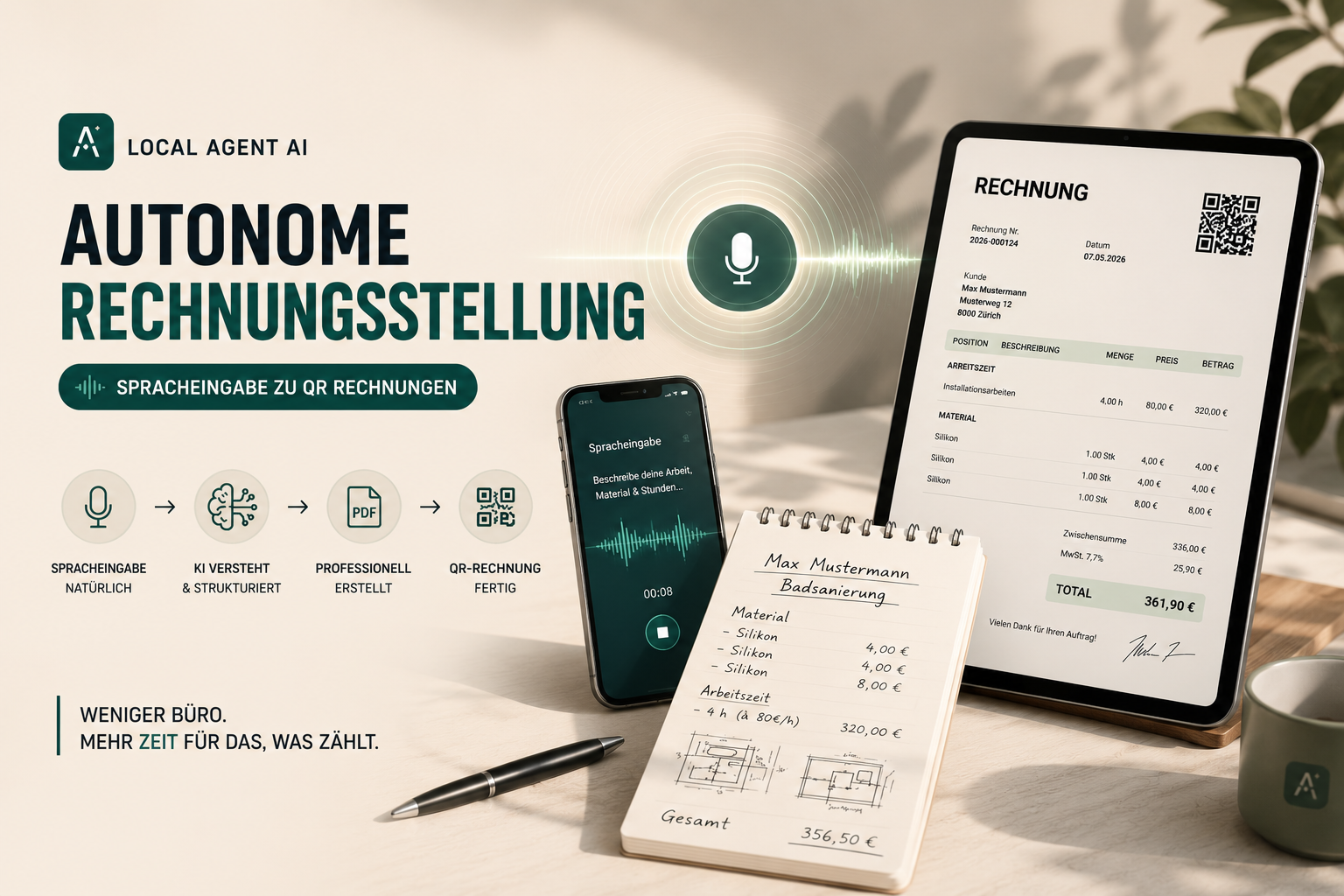
Tool calling: from instruction to executable action
Tool calling connects the interpretation of an instruction to an application function. The agent prepares a call with structured parameters, and the selected tool performs the processing. PDF generation therefore remains a separate component of the invoicing workflow.
A simplified view of the workflow is:
Speech or note photo → structured information
AI Agent + schema → tool call → PDF with QR payment section
I was interested in how well this handover works: which tool matches the instruction? Are the required parameters available? Do they conform to the schema expected by the function? Plausible text is not enough at this interface; it needs to become a processable call.
The embedded video provides a glimpse of the project.
Understanding the schema and making targeted changes
The schema describes how invoice data is structured: which fields exist, which values they accept and how line items relate to one another. The agent needs to understand this structure so that an instruction affects the right part of the data.
A simplified example: a material item contains three cartridges of silicone. The instruction is: “Change the quantity of this item to four.” The intended change concerns the quantity of that item. Customer details, other items and the description should remain intact.
These individual changes were an important part of the experiment for me. Does the agent understand which field is meant? Can it modify existing data in accordance with the schema? Does the resulting structure remain suitable for the next tool call?
This example illustrates the task; it does not represent a customer job or a measured success rate.
Offline operation and performance as requirements
The workflow needed to operate offline and efficiently. For me, that meant considering agent orchestration together with local application functions: how much work does interpreting an instruction, modifying the data and making the subsequent tool call introduce?
A useful next comparison would examine complete workflows: elapsed time, resource requirements and the reliability of the generated calls. Particularly for a small change to an existing invoice, the additional agent step should justify its overhead.
Efficiency therefore remains a concrete implementation question that I want to investigate further with comparable test cases.
Why an agent rather than a direct export?
When all invoice data is already complete and structured, software can pass it directly to PDF generation. An agent adds a processing step. Whether that step provides an advantage therefore needs to be validated against a direct export.
One possible strength lies in handling natural-language instructions and changes: taking information from speech or notes, modifying an existing item and calling the appropriate tools. Whether this makes the workflow simpler or more efficient can only be judged through comparison.
For me, Voice to Swiss Bill demonstrates one way to connect these components. The experiment deepened my understanding of tool calling, schemas and the division of responsibilities between agent and application. The learning came from trying this connection in practice and being able to ask more precisely what value it adds.